

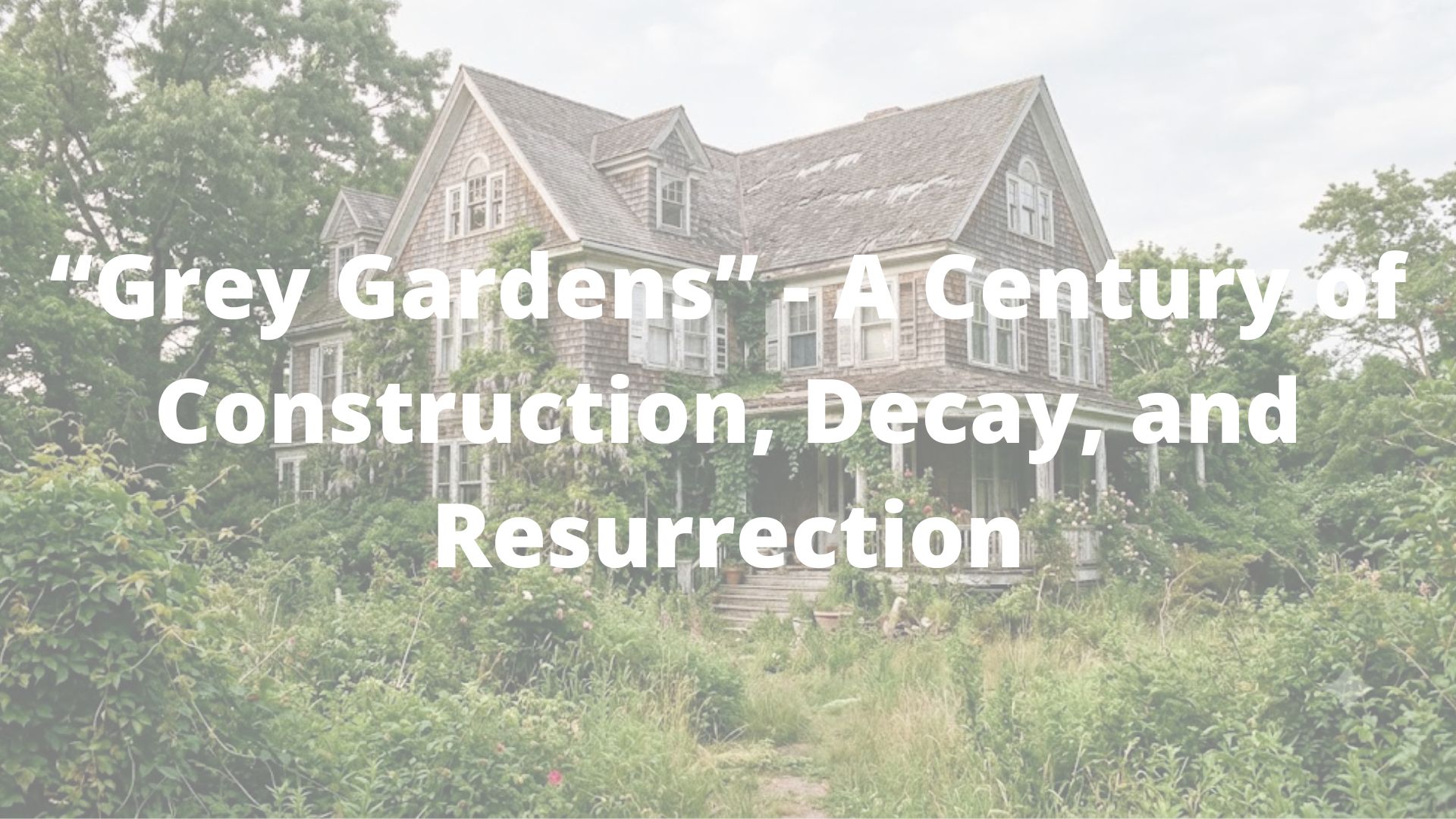
 A sprawling, shingle-style mansion sitting on the corner of West End Road and Lily Pond Lane in East Hampton, Grey Gardens is perhaps the most mythologized home in America. To the world, it is the setting of a legendary documentary where “Big Edie” and “Little Edie” Bouvier Beale, the aunt and cousin of Jacqueline Kennedy Onassis, lived in a state of poetic, flea-ridden, and deeply eccentric isolation.
But beneath the layers of bohemian mythology lies a fascinating, tumultuous, and often-delayed architectural journey.
Phase 1:
Long before the Beales ever set foot on the property, Grey Gardens was plagued by drama. A wealthy dry-goods merchant and his wife purchased the 4-acre oceanfront plot. They hired renowned Arts and Crafts architect Joseph Greenleaf Thorp to design a classic 14-room Shingle Style summer cottage.
The Facts:
- The Ghost Deed: Just as plans were drawn up, construction hit a major roadblock. A title search revealed that a previous landowner had bequeathed the land to the U.S. government.
- The Autopsy & The Will: Before the title could be cleared, the owner died unexpectedly. His brother sued the widow for the estate, claiming she had used “undue influence” and had her husband’s body hastily cremated so officials couldn’t perform an autopsy.
The widow eventually won the court battle, cleared the deed, and finished the house—though she barely lived in it.
Phase 2:
A coal industry executive bought the estate next. His wife, Anna Gilman Hill, was an elite gardener and author. She looked at the barren dunes and decided to transform them.
The Facts:
Anna Hill hired landscape designer Ruth Bramley Dean to build a formal, Spanish-style walled garden. To protect her delicate roses, lavender, and delphinium from the harsh, salty ocean winds, Anna imported ornate concrete walls directly from Spain.
- The Name: The combination of the grey cement walls, the sea mist, and the soft pastel colors of her chosen flora inspired Anna to name the estate “Grey Gardens.”
- The Solarium: During this phase, the open porch on the side of the house was enclosed with distinctive diamond-pane windows, creating a sunroom that would become an iconic visual anchor of the home.
Phase 3:
The house was eventually purchased for Edith Bouvier Beale. For a decade, Grey Gardens was the jewel of the Hamptons high society. But after a sudden divorce left Edith with a pittance for upkeep, the ocean air and rampant nature began to reclaim the house.
The Facts:
By the early 1970s, the mansion had devolved into a biohazard.
- The “Raids”: The Suffolk County Health Department inspected the home and issued an eviction notice. They found no running water or heat, structural decay, raccoons nesting in the attic, and the waste of over 50 feral cats.
- The Band-Aid: Jackie Onassis and her sister, Lee Radziwill, stepped in, donating funds to clean up the trash, repair the plumbing, and secure the basic structure so the Edies could legally stay. However, this was a patch job; the house remained deeply weathered, and the gardens were entirely swallowed by thick ivy and bittersweet vines.
Phase 4:
Following the death of “Big Edie,” “Little Edie” could no longer maintain the house. She sold it to legendary editor Ben Bradlee and his wife, columnist Sally Quinn, on one strict condition: “Do not tear it down.”
“All it needs is a coat of paint!” Little Edie famously told them. It needed much, much more.
The Facts:
Quinn and Bradlee spent years painstakingly restoring the home.
- The Cat-Urine Problem: The wooden floors were so deeply saturated with decades of cat urine that they had to be completely gutted and replaced.
- Salvage Operations: Despite the rot, they salvaged the original moldings, staircase, and even 80% of the furniture left behind by the Beales.
- The Garden Bulldozer: The legendary walled garden was deemed a total loss. Quinn had it bulldozed and replanted, keeping it “just on the edge of looking overgrown” to maintain its wild, mysterious spirit.
Phase 5:
In 2017, fashion designer Liz Lange bought the home and embarked on the most structurally ambitious renovation in Grey Gardens’ history.
The Facts:
Working with prestigious historical architects, Lange did what previous owners never could:
- Lifting the Mansion: Builders literally raised the entire historic, three-story shingled home into the air to dig out a full, 4,000-square-foot subterranean basement where only a shallow crawlspace had existed before.
- Modernizing Invisibly: The new basement allowed them to hide modern HVAC, plumbing, and electrical systems, keeping the historical aesthetics upstairs completely untouched.
- Diamond-Glass Restoration: They rebuilt the iconic diamond-paned windows using authentic, slightly distorted restoration glass to match the original turn-of-the-century vision.
Today, Grey Gardens is a fully modernized masterpiece, complete with a pool pavilion, radiant-heated floors, and manicured gardens. Yet, even under its pristine, multimillion-dollar polish, the home still retains that coastal, slightly haunting magic of its past.

John Caravella Esq., is a construction attorney and formerly practicing project architect at The Law Office of John Caravella, P.C., representing architects, engineers, contractors, subcontractors, and owners in all phases of contract preparation, litigation, and arbitration across New York and Florida. He also serves as an arbitrator to the American Arbitration Association Construction Industry Panel. Mr. Caravella can be reached by email: [email protected] or (631) 608-1346.
The information provided on this website does not, and is not intended to, constitute legal advice; instead, all information, content, and materials available on this site are for general informational purposes only. Readers of this website should contact their attorney to obtain advice with respect to any particular legal matter. No reader, user, or browser of this site should act or refrain from acting on the basis of information on this site without first seeking legal advice from counsel in the relevant jurisdiction. Only your individual attorney can provide assurances that the information contained herein – and your interpretation of it – is applicable or appropriate to your particular situation. Use of, and access to, this website or any of the links or resources contained within the site do not create an attorney-client relationship between the reader, user, or browser and website authors, contributors, contributing law firms, or committee members and their respective employers.
References
- Maysles, A., Maysles, D., Hovde, E., & Meyer, M. (Directors). (1975). Grey Gardens [Documentary]. Portrait Films.
- Quinn, S. (1984). Articles and memoirs on the acquisition and restoration of Grey Gardens. The Washington Post.
- Lange, L. (2018). Interviews and architectural design reviews on the subterranean preservation project of Grey Gardens. Architectural Digest.
- Suffolk County Department of Health Services. (1972). Public health inspection records and citation reports for the Beale Estate, East Hampton, NY.
- Historical Landmark Records of East Hampton. Architectural blueprints of Joseph Greenleaf Thorp (1897) and garden layouts by Ruth Bramley Dean (1913).